
In August I read eight AI Planning 2027 reports back to back. Semrush and Adobe on search visibility. McKinsey on what agents actually cost. Isentia on trust across Australia and the region. StackAdapt on what advertisers will let AI do. OneTrust on accountability. Gartner on project failure. Schema App on machine-readable data. Adweek scoring its own predictions at half time.
They come from six industries that never cite each other. Media intelligence people don’t read programmatic ad research. SEO people don’t read management consulting. AI Planning 2027 isn’t discussed across these groups.
They arrive at the same conclusion anyway.
The thing six reports agree on without noticing
What decides whether AI works for your business isn’t the AI. It’s the quality and consistency of what your business has made available for the AI to work from.
McKinsey put it most plainly in July 2026. Data and context become more valuable than the model itself, because the same commercial agent produces radically different results depending on the context it receives. Their advice is to start capturing that context now and plan on a three-year horizon.
Semrush and Adobe reached it from the search side. Their AI Visibility Index, built on 126 million real user prompts, found that the brands AI describes accurately aren’t the ones publishing the most. They’re the ones sending a consistent signal across the sources AI actually quotes. The report’s own summary of the shift is that content production has to move “from articles to assets”.
Isentia reached it from the reputation side, and said it best. “You can’t control what an LLM says about you, but you can control what it has to work with.”
StackAdapt reached it by accident. They asked 500 marketing and advertising professionals why they ignore AI recommendations, and the top answer, at 42%, was that the recommendation “feels generic or irrelevant to my campaign”. That isn’t a capability failure. The machine didn’t lack intelligence. It lacked context about the business it was advising.
Schema App reached it from the technical side. Agents can’t act on what they can’t interpret.
Additionally, at the Adweek session on 25 August, the panel was asked for one immediate action. Tejas Manohar of Hightouch said to build a central store of your brand context and guidelines.
Six sources. One answer. Nobody has stacked them up next to each other, which is the only reason it still counts as an observation.
Which brings me to what businesses here in NZ have been doing
MYOB’s 2026 Business Monitor surveyed 1,026 New Zealand business owners, managers and directors, reported in August 2026. It found 36% of New Zealand SMEs proactively using AI, up from 32%, and relates to AI Planning 2027.
Look at what they use it for. Social media and marketing content is the most common answer at 38%. Copywriting for marketing materials comes next at 28%. Technical documents and reports at 26%. Market, trend and risk analysis at 25%.
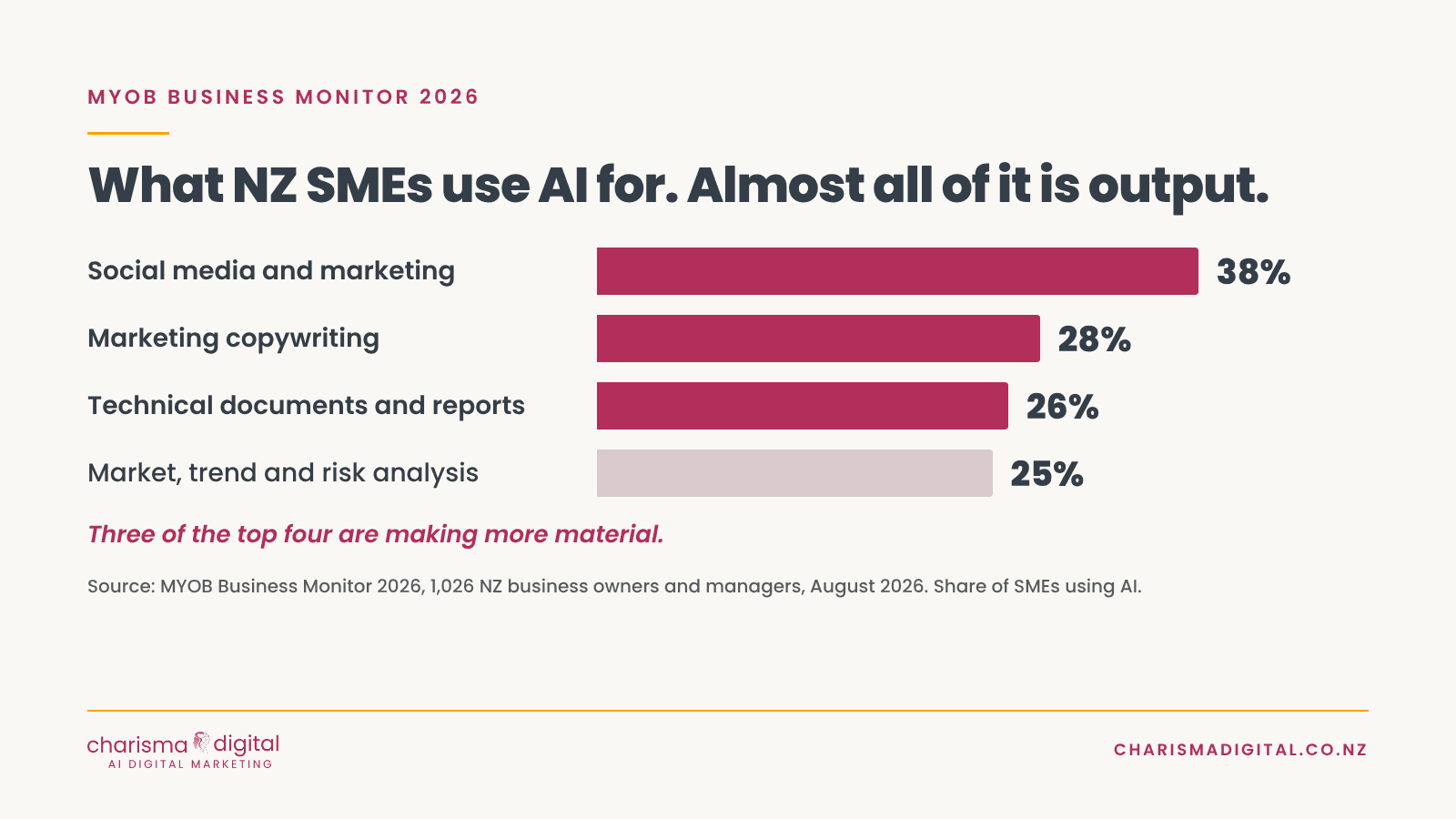
Almost all of it is output.
MBIE commissioned The Research Agency to survey 500 New Zealand SMEs, with data collected between April and June 2025, and found awareness was never the problem. 94% were already aware of at least one AI tool. What held businesses back was confidence, capability, and not knowing where to start.
So New Zealand businesses know the tools exist. They bought them. They pointed them at making more marketing material.
And every serious report published this year says the thing that will decide marketing results in 2027 sits at the other end entirely. Not what you produce. What you’ve made available to be understood, quoted and recommended.
That’s the gap I’d focus on closing. Here’s what it breaks into.
One. Context becomes the asset
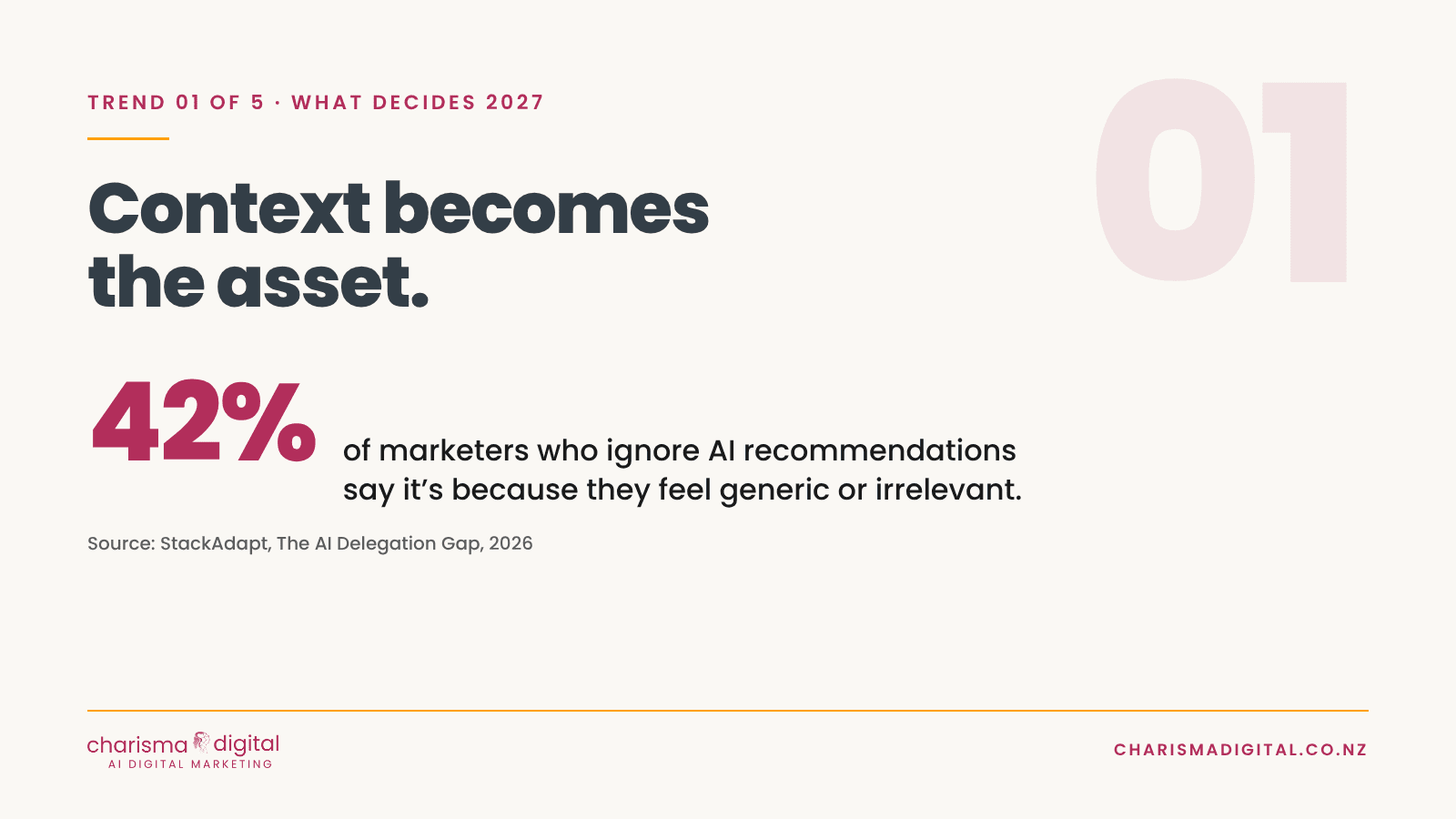
The businesses that will get useful work out of AI in 2027 are the ones that have written down what they are.
Not a brand deck. A working store of what you sell, what it costs, who it’s for, what you will and won’t claim, how you talk, what you’ve stopped offering. Somewhere a machine can read it and a new contractor could too.
McKinsey’s framing is that this compounds. They describe a three-year horizon where accumulated context produces different results from software that is otherwise identical to a competitor’s. Semrush’s version is that the moat is no longer the content on your own site, because anyone can produce that now.
What I’d do. One document, one afternoon. I wrote about what goes in it in why context beats prompts every time. It’s the cheapest competitive advantage on this entire list and it costs writing rather than money.
Two. Being mentioned and being cited become two different jobs
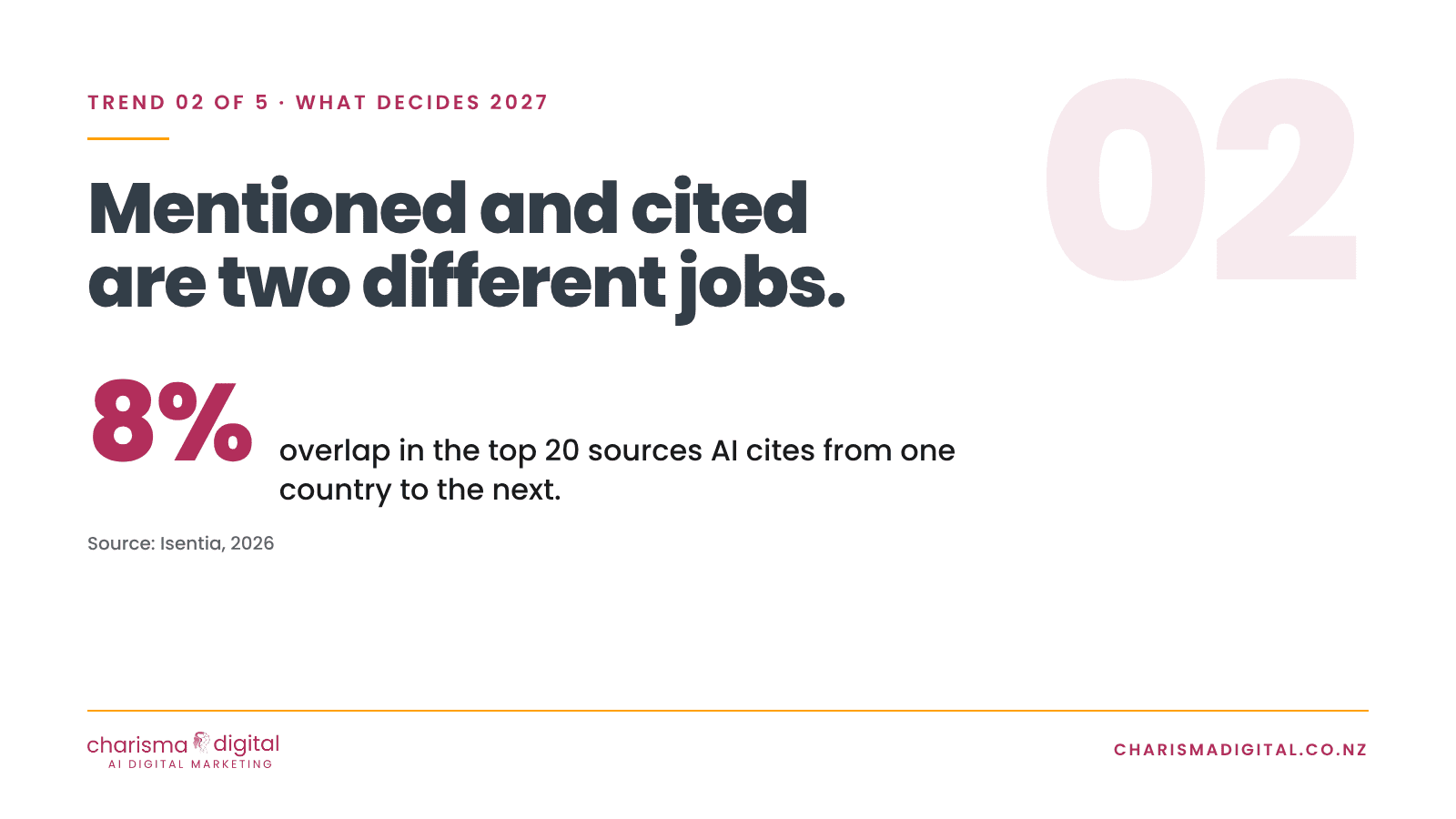
Semrush’s founding distinction is worth learning. A mention is when AI names your business in its answer. A citation is when AI quotes your website as a source. They’re independent, they’re earned differently, and most businesses track neither.
Mentions come from category authority. Citations come from content depth. A citation carries a link and can send you a click. A mention carries no link at all, sits inside the answer the reader is actually reading, and is invisible in your analytics.
Then there’s the part that matters here. Isentia, measuring across Australian organisations, found only 8% overlap between the top 20 sources cited by AI across different countries, and 6% across different sectors. Semrush’s entire 126-million-prompt index is United States only.
Which means the list of sources that shape how AI describes a New Zealand business is a New Zealand list. It isn’t the American one. Nobody has written it down for your category, and the businesses that work theirs out first will be describing themselves accurately while their competitors are guessing.
What I’d do. Ask ChatGPT, Google’s AI answers and Perplexity what your business does, then ask where they got that. The sources they name are your actual list.
Three. How you use AI becomes part of your reputation
This is the trend I’d take most seriously, and New Zealand has better data on it than anywhere else I looked.
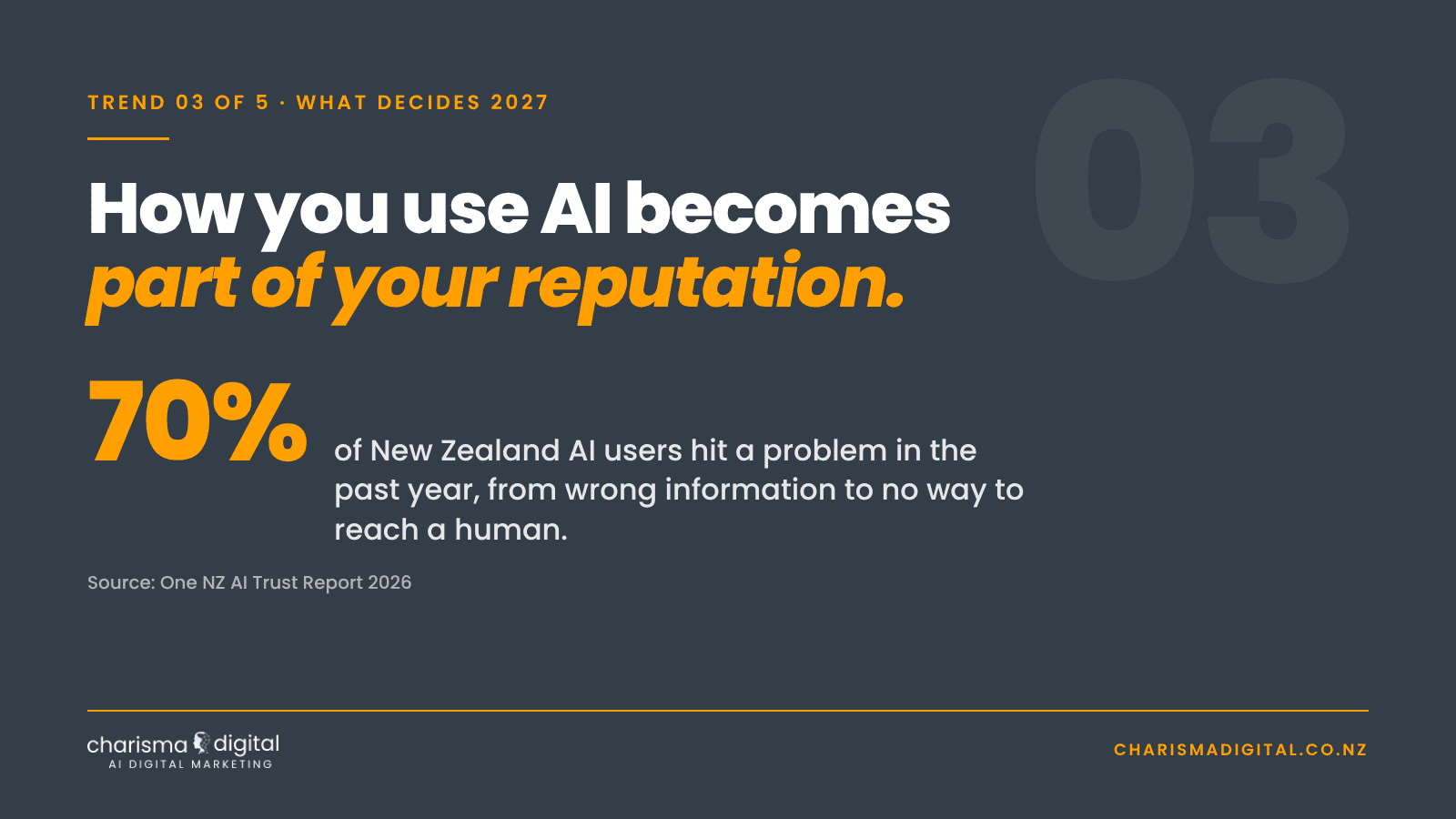
One NZ’s AI Trust Report 2026 surveyed 1,001 New Zealanders in March, weighted to census, with a margin of error of 3%. 76% had used an AI tool or service in the past year. 70% of those users hit a problem with it, meaning wrong information, a privacy concern, a poor result, or no way to reach a human.
Read that list again. Every item on it is a setup problem. Wrong information comes from AI working without the right context about the business. No way to reach a human is a design choice someone made.
People are using AI, and they’ve noticed the difference between AI that’s been set up properly and AI that hasn’t. 62% said they’d stop using a product or service if they were concerned about how an organisation was using it. One NZ recorded the same 62% in March 2025, so this is a settled expectation rather than a passing worry. They expect it to be done well.
Isentia’s work explains why it spreads. Audiences now use AI as a first responder and then check it somewhere they trust more, usually a forum or a community. People literally reply to posts asking an AI whether the thing they just read is true. How your AI behaves gets talked about in rooms you don’t own and can’t post in.
What I’d do. Walk through every place a customer meets your AI and check two things. Does it have the right information about your business, and can the customer reach a person easily? 68% of New Zealanders said the option to speak to a human would make them more comfortable with AI in customer interactions. If you’re small, that isn’t a feature you have to build. It’s the thing you already are, and most small businesses hide it.
Four. The delegation line gets drawn, mostly by accident
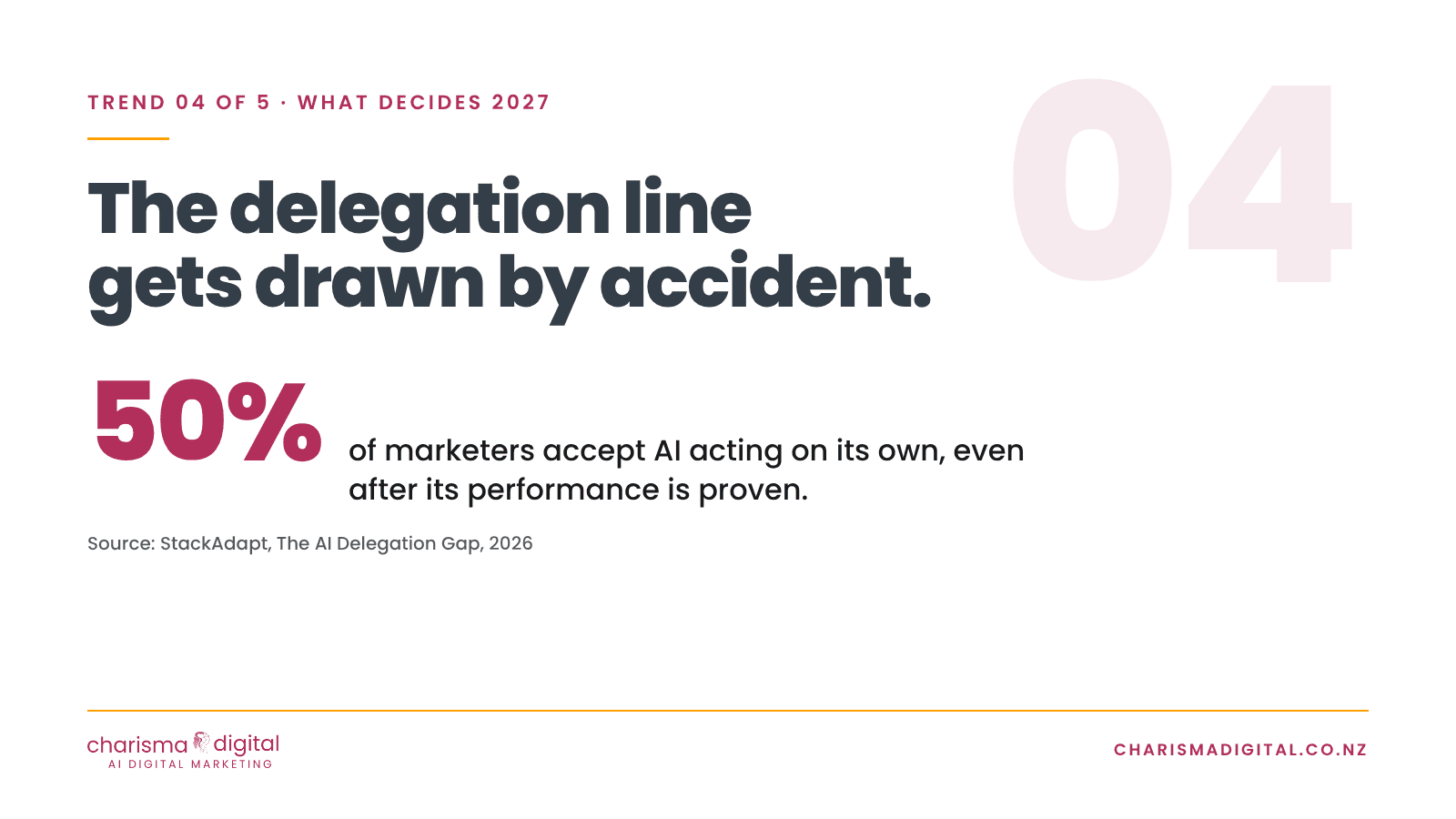
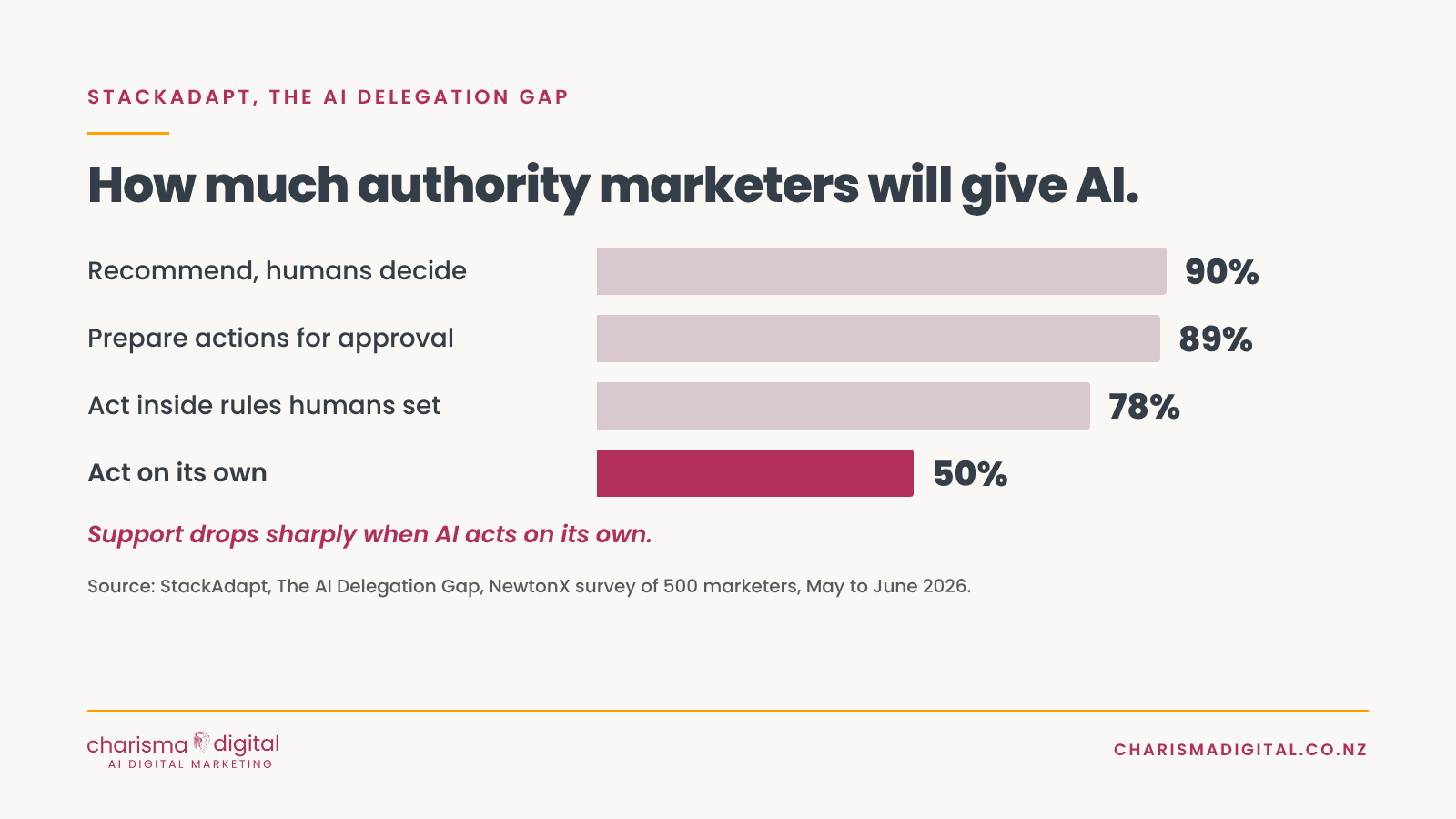
StackAdapt’s most useful chart is a scale of how much authority marketers will grant AI. 90% agree AI should recommend actions and let humans decide. 89% will let it prepare actions for approval. 78% will let it act inside rules humans set. Only 50% accept it operating on its own, even after performance is proven.
Then the quiet finding. Only 22% said they had deliberately chosen most of the automation currently running in their accounts. For everyone else, at least some of it arrived as a default.
If you run Performance Max, or Advantage+, or any of the platform automation that switched itself on this year, you’ve already delegated. It just never got written down.
Meanwhile the accountability is moving toward you. Ojas Rege of OneTrust made the point on the Adweek panel and OneTrust’s own 2026 predictions report makes it at length. Accountability is shifting from the companies building AI to the businesses deploying it. You didn’t train the model. You still answer for what it said in your name.
What I’d do. Write down which tools are running, what they’re allowed to change on their own, and who checks. It’s one page. In a small business the accountability question is easy to answer, which is an advantage worth using rather than an obligation to dread.
Five. The bill arrives and someone asks what it bought
Gartner forecasts that over 40% of agentic AI projects will be cancelled by the end of 2027. It made a similar call in 2024, predicting that 30% of generative AI projects would be abandoned after proof of concept by the end of 2025.
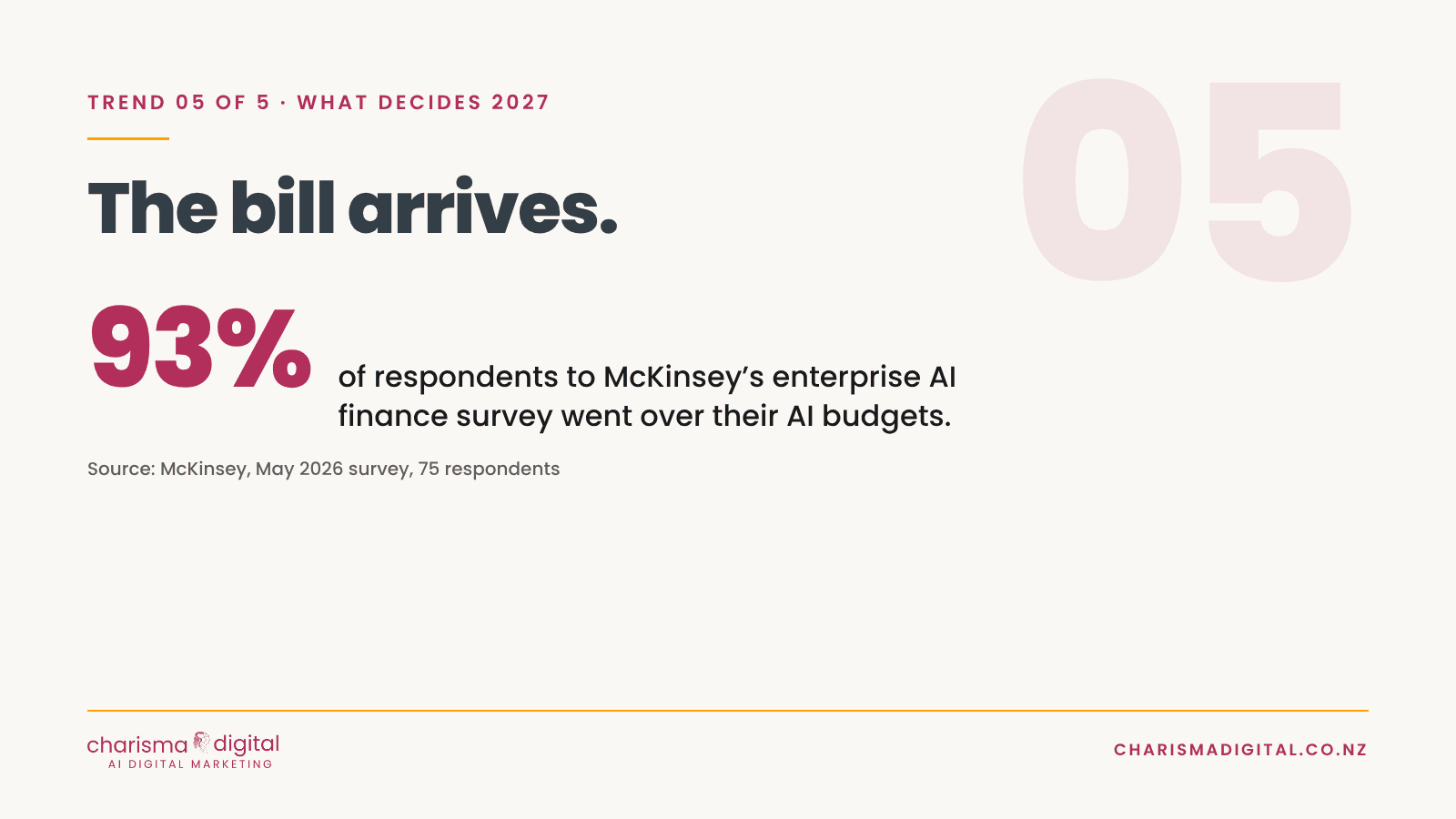
McKinsey supplies the mechanism. 93% of the 75 qualified respondents to their May 2026 enterprise AI finance survey had exceeded their AI budgets, even though the price of the underlying models collapsed. Agentic tasks can consume roughly 1,000 times more tokens than code reasoning, in the coding workloads McKinsey cites. About 60% of an agentic task’s cost goes on checking and refining the answer, and the same task can cost 30 times more depending on how it’s executed.
The New Zealand version of this is already visible. MYOB found 28% of SMEs said AI helped them maintain margins and 19% said margins improved. Among businesses with 20 or more staff, those numbers were 55% and 23%.
So fewer than one in five New Zealand SMEs can point to a margin that actually improved.
The entry cost was never the problem. The AI Forum found 70% of organisations reporting AI setup costs under $5,000, and only 4% spending over $50,000, down from nearly 20% a year earlier. Getting in is cheap. Proving it worked is the hard part, and 2027 is when people start being asked.
What I’d do. Count tasks removed, not tools bought. StackAdapt found 62% of marketers reporting less manual optimisation time but only 27% reporting better return on ad spend. Nate Elliott of EMARKETER put the problem in one line in that report. Efficiency wins fans, but effectiveness wins funds.
The part where being small helps
Read all eight reports together and most of the barriers they describe are barriers of scale. Fragmented data across systems nobody owns. StackAdapt found 17% of marketers saying there’s no clear accountability when an AI-driven decision goes wrong. Leadership expectations running ahead of what the team can deliver. Legal arriving at the end to say no.
A New Zealand business of one to 20 people has almost none of those problems. The person deciding is the person building. The accountability question answers itself. The context McKinsey says compounds into an advantage over three years is sitting in your head already, and the only work is getting it out.
Summer Collins of One NZ put the opportunity plainly. AI is cutting the cost of building things in ways that could let smaller countries compete well beyond their traditional scale.
That’s available. It just isn’t automatic, and it doesn’t come from producing more marketing content faster.
The test
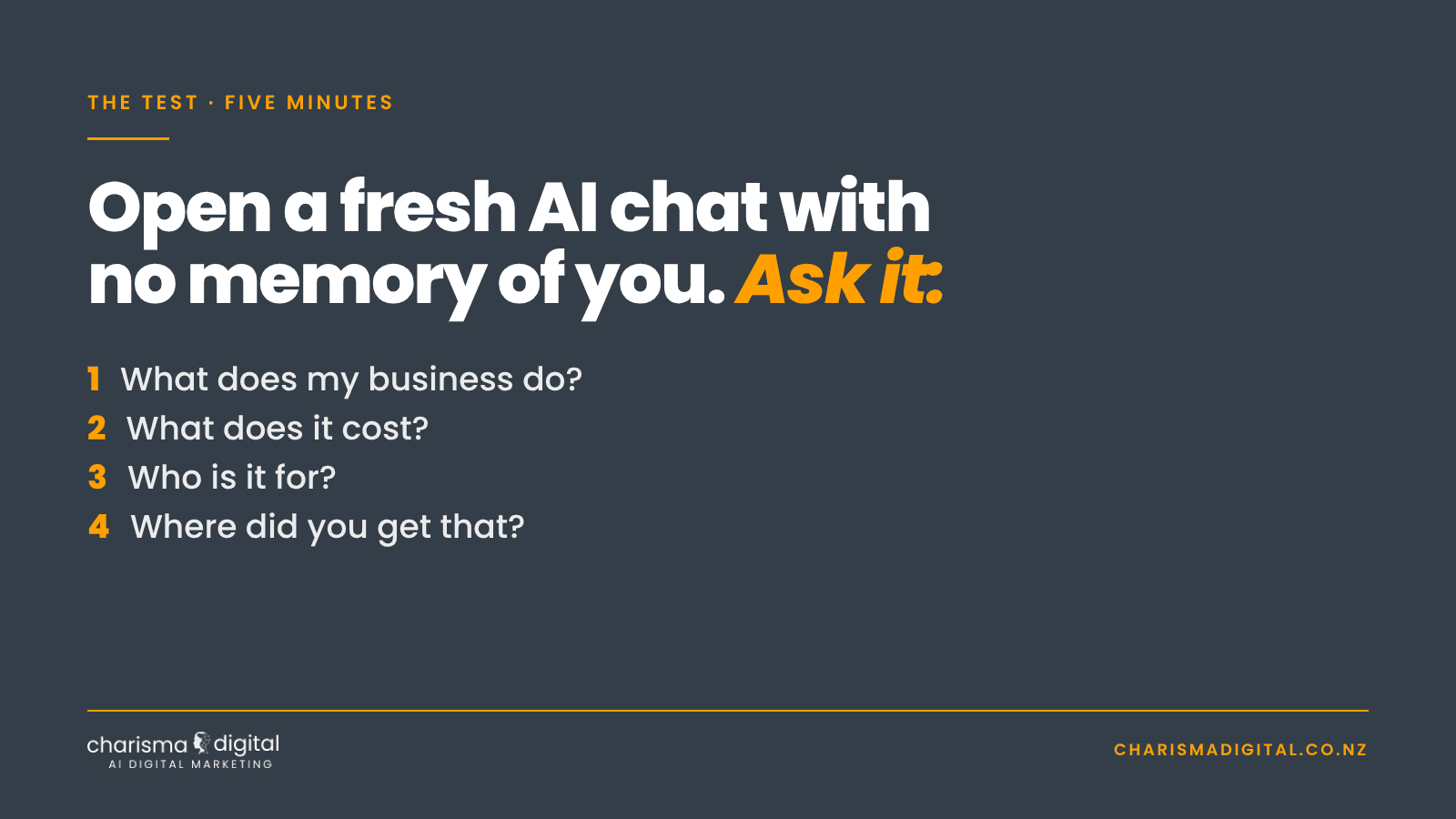
Open a fresh AI chat with no memory of you. Ask it three things. What does my business do, what does it cost, and who is it for.
Then ask it one more. Where did you get that.
If the answers are right, your context is doing its job and you can go and work on the rest of this list. If they’re wrong, or vague, or describing the business you were two years ago, you’ve found your 2027 project, and it isn’t a technology project.
If that test turned up your 2027 project, I built a free playbook for exactly this. The AI Marketing Planning Playbook 2027 takes about twenty minutes to start. It scores the marketing jobs AI is already touching in your business, works out what AI actually costs a team your size, and turns both into a plan.
Which of the five would you argue with? I have a view on which one I’ve underweighted myself, and I’d rather hear yours first.
Sources
- MYOB Business Monitor 2026. Survey of 1,026 New Zealand business owners, managers and directors, weighted by industry, location and employee count. Reported 4 August 2026.
- One NZ AI Trust Report 2026. Conducted by Perceptive. Nationally representative online survey of 1,001 New Zealanders aged 18 and over, weighted to Statistics New Zealand census data. Fieldwork 6 to 20 March 2026, margin of error 3%. Published 26 May 2026. The 2025 edition, fieldwork 6 to 20 March 2025, is used here for the year-on-year comparison.
- AI Forum of New Zealand, AI in Action, third AI productivity report, August 2025. A survey of organisations, and the most recent edition at the time of publishing.
- MBIE, AI adoption by New Zealand small and medium-sized businesses. Research by The Research Agency. 500 SMEs, data collected April to June 2025, published July 2025.
- Semrush and Adobe, AI Visibility Index 2026. Built on a United States prompt database of 126 million deduplicated prompts, January to April 2026, across ChatGPT, Gemini, Google AI Mode and Google AI Overviews.
- Isentia, How AI is destabilising trust and reputation amongst audiences. Data collected 1 June 2024 to 18 June 2026, worldwide and Australia.
- StackAdapt, The AI Delegation Gap. Survey fielded by NewtonX, 500 marketing and advertising professionals at mid-sized and enterprise organisations across six markets, 19 May to 8 June 2026. Australia n=84. Published 19 August 2026.
- McKinsey QuantumBlack, Is that AI agent worth it? Agentic economics and the modern operating model, July 2026.
- OneTrust, 2026 Predictions Report: Into the Age of AI, 2026.
- Gartner. Press release, 25 June 2025, on agentic AI project cancellations by the end of 2027. Press release, 29 July 2024, on generative AI projects abandoned after proof of concept. Pinpoint High-Impact AI Use Cases and Develop Your AI Roadmap, 2026.
- Schema App, The Agentic Web: what marketers must do to prepare, 2026.
- Adweek, 2026 AI Predictions: The Midyear Report Card, webinar, 25 August 2026.
A note on sourcing. Seven of these are published by companies selling the answer their research points to. Semrush sells visibility tracking, StackAdapt sells the ad platform, Schema App sells structured data, Isentia sells media monitoring, OneTrust sells governance software, MYOB sells business software, and the Gartner document listed here is a brochure for a Gartner product. The research behind them is mostly sound and StackAdapt in particular is unusually honest about what its own data can’t prove. It’s still worth knowing who paid for the question.


