
I get asked this question at least once a week. Usually by a business owner who has tried one, had mixed results, and wonders if the other would be better.
The short answer
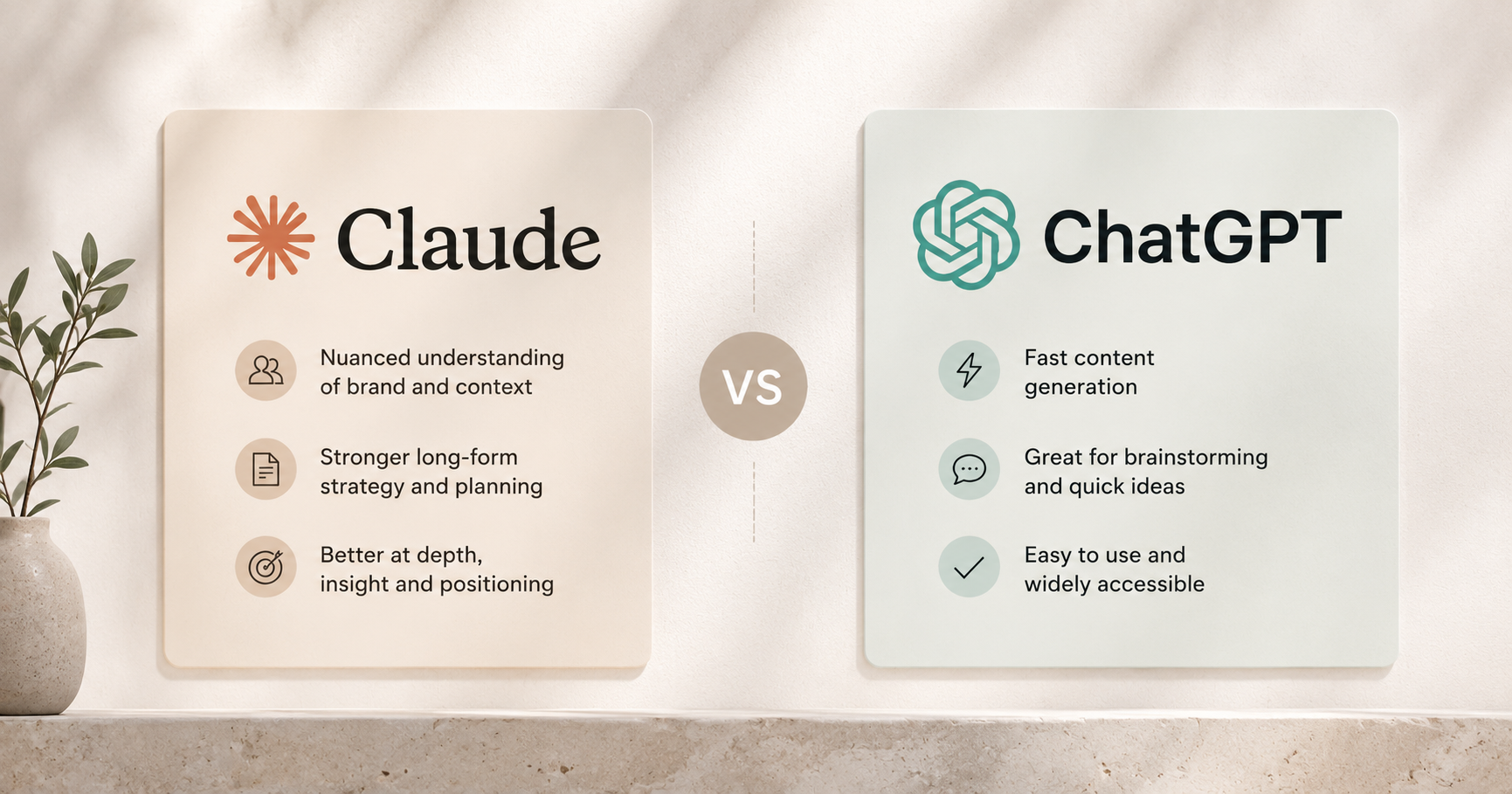
For brand voice, long documents, and writing that needs to sound considered, I choose Claude. For research, data analysis, connected apps, and creating images in the same workspace, I choose ChatGPT.
If you only want one tool for day-to-day small-business marketing, start with the work you do most often. Neither fixes a weak brief, missing customer insight, or a brand voice that only exists in your head.
Here is my working comparison after using both extensively for marketing work.
What ChatGPT does well
ChatGPT is flexible, fast, and widely integrated. Its plugin ecosystem is broad. If you want to connect your AI to other tools, platforms, and workflows, ChatGPT has more options available right now.
It handles a wide range of tasks competently. Drafting, summarising, research, coding, image generation. The breadth is genuinely useful.
For businesses already embedded in the OpenAI ecosystem or using tools that integrate with ChatGPT natively, it makes sense to stay there.
What Claude does well
Claude handles long context better than any other tool I have used. You can load extensive brand documents, audience files, and business context and it holds that information consistently across a long session.
For marketing work, this matters a great deal. Brand voice consistency across multiple pieces of content, in the same session, without drift. That is where Claude outperforms.
The writing quality is also different. Claude produces output that feels more considered, more nuanced, and less formulaic. For businesses where voice is the competitive advantage, that gap is noticeable.
Projects in Claude allow you to create a persistent workspace with documents loaded permanently. Every time you start a new conversation in that project, the context is already there. Your brand voice file, your audience intelligence, your business context. Loaded once. Always present.
ChatGPT now has Projects too, so persistent context is no longer a Claude-only advantage. Its wider set of connected apps, web research, data tools, and image generation can make it the more practical all-round workspace. Features change quickly, so check the current ChatGPT Projects and Claude Artifacts documentation before choosing on one feature alone.
Claude vs ChatGPT by marketing task
| Marketing task | My pick | Why |
|---|---|---|
| Brand voice and long-form writing | Claude | More consistent tone across long, context-heavy sessions. |
| Working from detailed brand documents | Claude | Strong at holding and applying large amounts of context. |
| Current research with sources | ChatGPT | Its research workflow is useful when freshness and citations matter. |
| Campaign data and spreadsheets | ChatGPT | A practical choice for analysis, files, and calculations in one place. |
| Social images and visual concepts | ChatGPT | Text and image generation sit inside the same workflow. |
| Drafting simple interactive tools | Claude | Artifacts make prototypes easy to build, review, and share. |
What I recommend for most NZ small businesses
For marketing work where brand voice consistency is the priority, I recommend Claude as the primary tool.
The context handling, the writing quality, and the Projects feature make it the better fit for the kind of work most small businesses are trying to do. Producing content that sounds like them. Not content that sounds like AI.
ChatGPT is useful as a secondary tool for tasks that benefit from its broader integrations or where you need image generation alongside text.
The most important thing is not which tool you choose. It is whether you have built the right foundation before you use it. The best tool with no context still produces generic output.
Either tool with a proper brand voice document, audience intelligence file, and business context produces something worth using. Build the foundation first. Then decide which tool to build it in. If those documents do not exist yet, start with the five documents every business needs before using AI for marketing, or look at the AI Foundation service.
Who should choose which?
Choose Claude if most of your work is writing, editing, thinking through strategy, or applying a detailed brand voice. Choose ChatGPT if you want one broad workspace for research, analysis, connected business tools, and images. Use both if the handoff is clear. One can research and analyse. The other can turn that material into careful, on-brand writing.
Frequently asked questions
Is Claude better than ChatGPT for marketing?
Not across every task. I prefer Claude for voice-led writing and long context. I prefer ChatGPT for research, data work, connected apps, and images.
Which is better for social media marketing?
ChatGPT is convenient when you need copy and images together. Claude is the stronger choice when consistent brand voice matters more than creating the visual in the same tool.
Can a small business use both?
Yes, but give each one a job. Otherwise you pay twice and create two versions of the truth. Keep the same approved brand and customer documents in both.
Will switching tools fix generic AI content?
No. Generic output usually starts with generic inputs. Fix the brand voice, audience intelligence, examples, and approval process before blaming the tool.


